How Marketers can Connect with Customers on Controversial Topics

What if you knew that your customers were unhappy with you or blaming you for a particular problem, even though they continue buying from you?

What if you could feel the weight of a growing concern amongst your customers, yet the issue is something no one knows how to easily solve?

With such awareness, would you ignore it, deny it, or open a dialogue about it?

Coca-Cola is one company that has recently decided to talk about a controversial topic of which they are well aware: obesity in America.

Earlier this year, Coca-Cola launched an ad campaign aimed at addressing the company’s role in obesity in America. The company even claims to have worked with school systems to offer bottled water and juices to children. They’re also making an effort to create low-calorie drink options, and offer smaller-sized sodas to help control portion size.

Is it hypocritical or misleading for the world’s largest beverage company to talk about a problem for which they are viewed as a prime source? On this controversial topic, there are clearly two groups: admirers and critics.

As a marketer, I personally admire them.

The Value of Awareness

In spite of their massive size, Coca-Cola has chosen to pull their head out of the sand, become fully aware of the world on which they helped create, and begin a dialogue with consumers on how to address the growing issue of obesity. Who better to help change consumer behavior then one of the best marketers in the world?

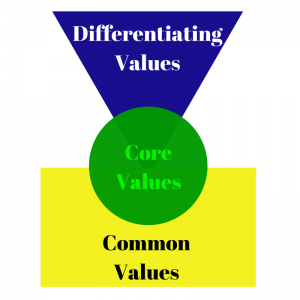
To start this process, the company first had to embrace the value of awareness. As a differentiating value, Awareness means having knowledge of; ability to perceive or feel.

It could be argued that Coca-Cola always knew what it was doing. However, the new awareness was the realization that if they don’t help address this major issue, consumers might ask others to do it for them (e.g. government agencies with regulations or insurance companies with higher premiums). Either way, Coca-Cola could experience negative results in sales if they continued to ignore the facts and perceptions.

So why now? What’s changed?

In the past, marketers primarily focused their research efforts on gathering data and information that helped them make more, sell more, or profit more. When anything negative or potentially harmful was uncovered, marketers turned to their PR experts to “handle it”.

But in an increasingly socially connected world, smart marketers are embracing awareness as a differentiating value. The knowledge of how customers really feel about major issues and concerns can open a door to connect and dialogue like nothing marketers have every experienced before.

Note: to do this, you don’t have to be a big multinational conglomerate like Coca-Cola.

3 Local Examples

  1. Imagine a mid-sized law firm in your community that openly acknowledges the negativity that many people feel about lawyers (e.g. snakes, dishonest, highly competitive). Maybe they provide a forum to dialogue on how to change this negative perception, or begin altering the behaviors that lead to this perception.
  2. Imagine a small community bank that addresses the problem of lack of trust and confidence in all banks (since the financial collapse of 2008), and the fact that community banks are viewed as unstable because of their size. In this case, it’s important customer conversations do not come across as advertising or trying to show the benefits of being small. The real value here is in opening a dialogue on how to the banking system needs to change in order to address the needs of local businesses and consumers.
  3. Imagine a small pharmaceutical company that chooses to engage in the touchy subject of costly prescription medication vs. lower-cost natural remedies. By doing this, are they risking that the FDA may frown upon their efforts, harming their chances of getting future drugs approved? Will an open dialogue with consumers cause the insurance companies to remove their drugs from the approved list, or from physicians prescribing them? In a world where consumers are becoming more self-educated patients and partnering with their doctor (instead of remaining passive), it make sense to have an open dialogue with consumers about what they are truly thinking and feeling.

But regardless if the conversation is local, national, or international, the process starts with the value of awareness.


What do you think of Coca-Cola’s approach?

How can the value of awareness help you create competitive advantage?


Today’s value was selected from the “Knowledge-Skillfulness” category, based on the e-book Developing Your Differentiating Values.


No Matter How You Grow Up, Patterns Can be Changed

Note: This blog post also appears on Leadership Couples. A number of months ago I had the privilege of interviewing a wonderful couple with an amazing story. It’s a beautiful story of redemption and restoration. Imagine growing up in an environment where your father is an alcoholic and a lousy role model. When you’re 11…

7 Ideas for Restoring Peace in Your Marriage

The value of peace means harmonious relations; freedom from disputes. Marriage Questions: Have you clearly defined what peace looks like for you and your spouse? What one thing can restore peace with your spouse like no other? Why that one? When you desire peace, what do you value most from your spouse? Have you told…

10 Reasons for Leaders to Establish Order

The value of order means bring into conformity with rules or principles or usage. Leadership Questions: Does everyone on your team know exactly what is expected of him or her? What needs to change to promote greater clarity of focus for your team? What principles have you established for your team to prioritize and make…

Values Quotes – Don Marquis on Punctuality

Todays quote is from Don Marquis, an American humorist, journalist, and author best remembered for creating the fictional characters “Archy and Mehitabel”. A great quote from Marquis is: “Punctuality is one of the cardinal business virtues; always insist on it in your subordinates.” I hope you can appreciate the humor in this quote, as it’s…

Why Agencies and ‘Creatives’ Play Inside the Brand Sandbox

The value of precision means sharply exact or accurate; consistent; perfect conformity to fact or truth. Marketing Questions: Have you developed clear brand guidelines for your creative teams and marketing agencies? Who is charged with being the brand steward or “logo police” in your organization? What have you done to educate all employees, including management,…

How to Overcome The Feeling of Uncertainty in Your Mission

The original version of this was posted on Leadership Couples, written by my wife Lori. This speaks to the differentiating value of Adventure, which means a wild and exciting undertaking; or risky activities. If you are ever feeling uncertain or ill equipped to handle your mission – from leading a youth group to leading your…

20 Ways to Refresh Your Marriage Through Relaxation

The value of relaxation means a feeling of refreshing tranquility and an absence of tension or worry. Marriage Questions: What’s the mental state you need to be in to fully enjoy a relaxing with your spouse? When is the best time of the week for you and your spouse to focus on relaxing together? What…

7 Ways for Gregarious Leaders to Remain Genuine

The value of gregariousness means seeking and enjoying being in crowds and socializing; or friendly. Leadership Questions: What drives your need to be social? What are the risks (and potential costs) of being too friendly with your team? How can you use your gregariousness to influence others in a positive, non-self-serving way? When socializing with…

Values Quotes – Saint Augustine on Delight

Todays quote is from Saint Augustine, also known as Augustine of Hippo, a father of the church who was active 400 years after Christ. His writings were very influential in the development of Western Christianity. An insightful quote from Augustine is: “The single desire that dominated my search for delight was simply to love and…

I write about differentiating values and their impact on leadership, marketing, and marriage - focused on couples in business together. Read more about Robert.